
Laura Archange
Partner | Legal
Luxembourg - Legal Services

Laura Archange
Partner
Luxembourg - Legal Services


Changes to Solvency II could make it easier for European insurers to invest in private funds and alternative credit through rated structures, strengthening the commercial case for rated feeders and collateralised fund obligations (CFOs).
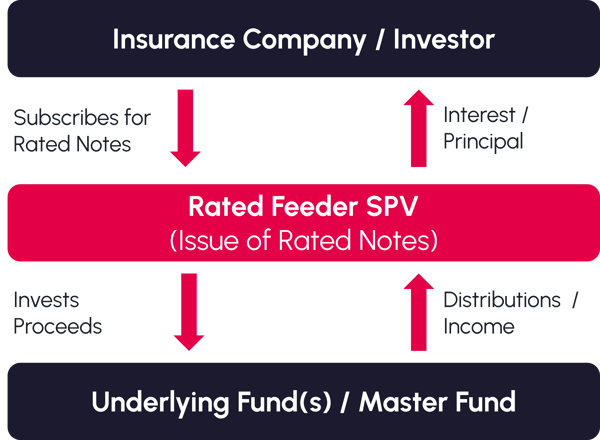
Rated feeders and CFOs can give insurers exposure to private market assets through rated debt securities rather than direct fund interests. Depending on the structure and rating, this can provide more favourable capital treatment under Solvency II and make certain investments more capital-efficient for insurers.
These structures are already well established in the US but changes to the Solvency II framework could now create greater scope for their use in Europe.
This article examines the regulatory changes, what they could mean for insurers and fund managers, and the structuring options available in Ireland, Luxembourg and the Cayman Islands.
The EU's risk-based prudential framework for insurance and reinsurance undertakings, Directive 2009/138/EC of the European Parliament and of the Council of 25 November 2009 on the taking-up and pursuit of the business of Insurance and Reinsurance (Solvency II), has historically made it capital-intensive for insurers in Europe to invest in alternative credit, private debt, and fund-based strategies, effectively removing European insurers from investing in these asset classes. This is in contrast to the US market.
At the outset, it is important to note that the Solvency II framework did not prohibit any asset class, but the way investments were classified determined the capital an insurer must hold against them. For example, direct holdings in alternative investment funds (AIFs) are typically treated as Type 2 equity (attracting a 49% stress factor) or require full look-through to the underlying assets, both of which result in punitive capital charges relative to the risk profile of the investment.
Due to recent regulatory changes, rated feeder fund and CFO structures are gaining traction as a solution: they repackage fund or loan exposures into rated, listed debt securities, allowing insurers to hold a fixed-income position with materially lower capital requirements.
Commission Delegated Regulation (EU) 2026/269 (the Amending Delegated Regulation), adopted on 29 October 2025 and expected to apply from 30 January 2027, amends the core Delegated Regulation (EU) 2015/35 (the Solvency II Delegated Regulation) across several areas directly relevant to these structures:
the spread risk charges for securitisation positions are recalibrated, reducing stress factors, particularly for senior, rated tranches and improving the capital efficiency of holding rated notes. In the context of non-STS securitisations, such as collateralised loan obligations (CLOs), the Amending Delegated Regulation differentiates between senior and non-senior tranches so that investment in senior tranches of non-STS securitisations will significantly reduce capital charges
the treatment of qualifying long-term equity investments is revised, widening the capital gap between holding alternative credit as a rated note versus a direct fund interest
changes to the volatility adjustment, risk margin and technical provisions improve insurers' overall balance-sheet capacity, freeing capital for deployment into structured credit
These reforms collectively strengthen the commercial case for rated feeder / CFO structures in several ways.
While the barrier to insurers investing in senior tranches of non-STS securitisations has now been removed, a rated feeder gives the insurer exposure to alternative fund strategies that are not themselves securitisations. For example, private equity funds, hedge funds, infrastructure funds, or private credit funds. Without the rated feeder wrapper, the insurer would hold a direct fund interest classified as Type 2 equity (49% stress factor) or subject to full look-through. The rated feeder repackages that fund exposure into rated debt, converting it from equity treatment to spread risk treatment.
In Ireland, a rated feeder would typically be structured as a designated activity company (DAC) established as an orphan entity, with its shares held on trust for charitable purposes. This ownership structure contributes to the bankruptcy remoteness of the DAC. The DAC is the standard Irish issuer vehicle for CLOs, securitisations and repackaging transactions and can generally be established quickly and at relatively low cost.
The DAC may issue one or more notes, which may be rated by a credit rating agency. The target rating will depend on the regulatory and capital requirements of the relevant institutional investor, the characteristics of the underlying assets and the credit enhancement mechanisms available to support the desired rating.
A single DAC may be established as a multi-series issuance platform, with each series relating to a separate investor, portfolio or transaction. The assets and liabilities attributable to each series would be contractually allocated to that series and subject to separate limited-recourse and non-petition provisions. This would enable the DAC to undertake multiple issuances without establishing a separate issuer for each investor or transaction.
The proceeds of each issuance would be applied by the DAC to acquire the relevant underlying assets or fund interests. The structure may accommodate different senior, mezzanine and subordinated tranches, currencies, interest profiles and amortisation terms. It can therefore be tailored to the requirements of the underlying fund, the rating agency and the relevant institutional investors. Unlike an investment fund, the DAC would not generally require regulatory authorisation merely to be established or to issue notes to institutional investors.
From an Irish tax perspective, the objective would be to achieve tax neutrality so that the rated feeder layer does not create material additional tax leakage compared with a direct investment in the underlying fund. Provided that it is appropriately structured and satisfies the applicable statutory conditions, the DAC may qualify as a securitisation company under section 110 of the Taxes Consolidation Act 1997. Its taxable profits would then generally be calculated after deducting its funding and other allowable expenses, which include profit-participating interest or other returns payable to investors. No advance tax ruling is required for the DAC to access the Section 110 regime.
In Luxembourg, where alternative investment funds are typically structured as special limited partnerships (sociétés en commandite spéciales or SCSps) issuing LP interests, a rated feeder is typically structured as a securitisation company governed by the Luxembourg law of 22 March 2004 on securitisation, as amended (the Luxembourg Securitisation Law).
A key feature of this regime is the ability to create segregated compartments within the same securitisation company, in a manner broadly comparable to sub-funds within a reserved alternative investment fund (RAIF). Each compartment may issue notes qualifying as debt instruments, which can be rated by a credit rating agency, with the target rating depending on the regulatory requirements of the relevant institutional investor and various credit enhancement mechanisms available to achieve the desired rating level.
Segregation between compartments is statutory, meaning that the law expressly gives effect to limited-recourse, non-petition and subordination provisions. This gives rating agencies and insurer investors a ring-fencing analysis grounded in statute and allows a sponsor to run a programme of rated feeders (by investor, currency, master fund or vintage) from a single vehicle.
Following the 2022 reform of the Luxembourg Securitisation Law, a securitisation vehicle may also be financed by loans as well as securities and may be set up in partnership form (including as an SCSp), giving additional flexibility in aligning the feeder with the master fund structure. When required, security interests over the issuer's accounts may be taken under the Luxembourg law of 5 August 2005 on financial collateral arrangements, which provides insolvency-remote security and enforcement without court involvement.
A Luxembourg securitisation company can generally be incorporated within a few business days, the notes may be governed by Luxembourg, English or New York law where investor familiarity requires it, and they can be listed on the Luxembourg Stock Exchange (Euro MTF or regulated market).
The proceeds of the notes' issuance are then used by the relevant compartment to acquire LP interests in the underlying fund (often a credit fund). A securitisation company will only require authorisation by, and become subject to the ongoing supervision of, the Commission de Surveillance du Secteur Financier (CSSF) where it issues securities to the public on a continuous basis, which is generally not the case for rated feeders placed with institutional investors.
While securitisation vehicles are the structure most commonly used, it is also possible to establish the feeder as an investment fund (for example, a RAIF, a specialised investment fund (SIF) or an investment company in risk capital (SICAR)), which may issue notes, or a combination of notes and LP interests, rather than being financed exclusively through LP interests.
From a Luxembourg tax perspective, the aim is to achieve neutrality, such that the rated feeder layer does not create additional tax leakage compared to a direct investment in the underlying fund.
Provided they are appropriately structured, Luxembourg rated feeders are typically designed to be neutral from corporate income tax, municipal business tax, net wealth tax, withholding tax and VAT perspectives. They may be implemented as securitisation vehicles or investment funds, with structuring options ranging from look-through to tax blocker structures and allowing the issuance of equity or debt interests, or a mix of both.
Tax treatment will depend on the chosen structure and investor base. In both Ireland and Luxembourg, key considerations may include treaty access, interest limitation and anti-hybrid rules, the VAT treatment of management and other fee flows and, where relevant, Pillar Two and transfer pricing.
There are also jurisdiction-specific considerations. For Irish structures, these include withholding tax, the deductibility of funding costs and the specific anti-avoidance provisions applicable to section 110 companies. In Luxembourg, the analysis may also need to consider municipal business tax and subscription tax.
In the United States, rated feeder and fund-linked note structures are already well established and operate at significant scale, with the market having matured enormously over the past few years.
In particular, US insurers have been active investors in CLOs, CFOs and rated note feeders for several years, driven by a more permissive regulatory framework under the National Association of Insurance Commissioners’ (NAIC) risk-based capital (RBC) regime.
The NAIC system sets how much surplus each insurer must hold and assigns capital charges based on credit rating designations rather than the securitisation-specific stress factors used under Solvency II, meaning a rated AAA note from a CFO or a rated feeder is typically treated comparably to a corporate bond of equivalent rating.
In contrast, an LP interest in a private credit fund, for example, is treated as equity for RBC purposes and attracts a charge of 30% to 45%, even where the fund's underlying assets are senior secured loans that would draw a far lower charge if held directly. This has allowed US insurers, who hold vast pools of long-duration capital and need long-dated, investment-grade assets to match their long-duration liabilities, to build substantial allocations to alternative credit via rated structures, and the US market now represents the largest global pool of insurance capital deployed through these vehicles.
The European reforms under Solvency II are, in many respects, an attempt to close the competitive gap and unlock a similar channel for European insurers, albeit within a regulatory framework that retains a more granular, securitisation-specific capital treatment.
The US market has frequently adopted the approach of using Cayman Islands structures for a rated feeder and such vehicles are being established both as standalone feeders and alongside standard feeder funds (taking equity investments).
In the latter structure, an additional vehicle uses the proceeds from the note issuance to invest directly in the master fund. This vehicle is often established as an exempted limited partnership (ELP), but can also be another type of legal entity such as an exempted company or limited liability company.
Under Cayman Islands law, ELPs, exempted companies and limited liability companies are able to issue debt securities which can be rated by a ratings agency. Indeed, rating agencies are very familiar with the rating of debt securities issued by Cayman Islands vehicles established as CLO issuers. The debt securities issued by the rated feeder will typically be constituted under a New York law (or other US law) governed indenture/note purchase agreement, as this also helps with the familiarity of the product when presenting it to prospective insurers.
Since the Cayman Islands does not have its own set of prescribed securitisation laws and regulations, the jurisdiction offers an appropriate degree of flexibility, and much of the structuring is designed to accommodate the relevant laws and regulations that are applicable to the targeted US investors (ie, US insurers).
Practically, given Cayman’s regular use by the North American fund market, it is common to see a Cayman Islands established rated feeder incorporating the same solutions on enforceability of debt calls used by Delaware entities (ie the separate and distinct route / dual-commitment model). Whilst not strictly necessary from a Cayman law perspective (debt commitments are not rendered unenforceable in an insolvency scenario), it again contributes to alignment of fund documentation between the "offshore" and "onshore" fund vehicles.
We anticipate the product, already a standard feature of the private capital toolkit, will continue to grow and evolve in the near to midterm. We expect the range of fund collateral in use in this space will broaden and that complex, multi-tranche horizontal structures will become more prevalent, potentially leading to a healthy secondaries market.
Whether you are establishing a new rated feeder or CFO vehicle to access insurance capital, adapting an existing structure for regulatory purposes, or looking for an integrated offshore and European service provider, Ogier can support the full lifecycle of the transaction from concept through to ongoing administration, including risk retention advice.
Ogier is a legal and professional services firm with global expertise in structured finance and capital markets across key finance centres including Ireland, the Cayman Islands, Luxembourg, Jersey, Guernsey and the BVI. We provide fully integrated legal, tax, listing agency and corporate services for structured vehicles.
Our legal and tax teams advise on all aspects of securitisation structures, including the establishment of issuer SPVs, as well as fund structures including rated feeders. Our dedicated Listing Agency team handles listing applications across Euronext Dublin, the Luxembourg Stock Exchange, the Vienna Stock Exchange, The International Stock Exchange (TISE) and the Cayman Islands Stock Exchange, among other global listing venues.
Ogier Global, our corporate services platform, provides end-to-end SPV administration (from incorporation, directorship and company secretarial services through to ongoing accounting, tax compliance, investor reporting and ESMA Article 7(1)(e) regulatory reporting).
For further information, contact our Structured Finance team.
Partner | Legal
Luxembourg - Legal Services
Laura Archange
Partner
Luxembourg - Legal Services

Partner | Legal
Ireland

Eoin Hamill
Partner
Ireland

Partner | Legal
Ireland

Richard Kelly
Partner
Ireland

Partner | Legal
Cayman Islands

Mark Santangeli
Partner
Cayman Islands
Ogier is a professional services firm with the knowledge and expertise to handle the most demanding and complex transactions and provide expert, efficient and cost-effective services to all our clients. We regularly win awards for the quality of our client service, our work and our people.
This client briefing has been prepared for clients and professional associates of Ogier. The information and expressions of opinion which it contains are not intended to be a comprehensive study or to provide legal advice and should not be treated as a substitute for specific advice concerning individual situations.
Regulatory information can be found under Legal Notice
Sign up to receive updates and newsletters from us.
Sign up