
Oisin McClenaghan
Partner | Legal
Ireland

Oisin McClenaghan
Partner
Ireland



Oisin McClenaghan
Team: Jennifer Dobbyn, Simon Keogh, John Perry, Dave Nolan, Laura Holtham, Margot Carty, Edwina Hilton, Arthur Gaskin
ON THIS PAGE
RELATED
The Qualifying Investor Alternative Investment Fund (the QIAIF) is the alternative investment fund regulatory classification of choice in Ireland. The QIAIF is available to professional and institutional investors that meet the criteria of ''Qualifying Investors''.
The QIAIF's popularity is in part due to its highly flexible structure and its suitability for a broad range of asset classes and investment strategies, including credit funds, private equity, hedge funds, hybrid strategies, real estate, infrastructure and loan origination.
The QIAIF is subject to the requirements of the Alternative Investment Fund Managers Directive (AIFMD).
The QIAIF is required to be authorised by the Central Bank of Ireland (the Central Bank). One of the key attractions of the QIAIF is its speed to market as it may avail of the Central Bank's 24-hour fast track authorisation process.
| Key feature | Information |
| Regulatory requirements | The QIAIF is subject to the requirements of AIFMD and the Central Bank's AIF Rulebook. |
| Speed to market | The QIAIF can avail of the Central Bank's 24-hour fast track authorisation process, subject to all service providers having received prior approval of the Central Bank. |
| Standalone / umbrella structure | The QIAIF may be structured as a standalone fund or as an umbrella fund with segregated liability between sub-funds / sleaves. |
| Liquidity | It is possible for a QIAIF to be structured as an open-ended or open-ended with limited liquidity or closed-ended structure. |
| Minimum permitted investment | The minimum initial investment in a QIAIF is €100,000 (subject to limited exemptions). |
| Investor criteria |
The categories of investor that may invest in a QIAIF are restricted to those that satisfy the ''Qualifying Investor'' criteria and are:
There are certain limited exemptions from these requirements. |
| Investment restrictions | The QIAIF is suitable for a broad range of asset classes. There are limited investment restrictions save for those that are loan origination and Irish property QIAIFs, which are subject to additional Central Bank requirements and investment restrictions. |
| Leverage | Save for QIAIFs structured as loan origination QIAIFs or Irish property QIAIFs, there are generally no borrowing or leverage limits, subject to the maximum limits disclosed to investors and set by the alternative investment fund manager (AIFM) / investment manager. |
| Service providers |
Required service providers to a QIAIF include:
The general partner to a QIAIF established as an ILP may be an Irish or non-Irish entity. Portfolio management may be delegated to an EEA or non-EEA discretionary investment manager domiciled and regulated in any of the following jurisdictions: Abu Dhabi, Australia, Bahamas, Bermuda, Brazil, Canada, Dubai, Guernsey, Hong Kong, India, Japan, Jersey, Malaysia, Mexico, Qatar, Singapore, South Africa, South Korea, Switzerland, the United States and the United Kingdom. |
| Structural features | Additional structural features such as fund of funds, master-feeders and the establishment of subsidiaries may be availed of. |
| Marketing |
A QIAIF which has an EEA AIFM appointed pursuant to AIFMD may avail of the pan-EEA marketing passport. A QIAIF which appoints a non-EEA AIFM may only be marketed under national private placement rules (where available). |
| Tax features: corporate structures (ICAV) |
No Irish taxes are applicable to the AUM of a QIAIF ICAV. The QIAIF ICAV is exempt from tax on any profits and gains in Ireland. No Irish stamp duty is applicable to the issue, transfer or redemption of shares in a QIAIF ICAV. The management and administration services provided to the QIAIF ICAV are typically VAT exempt. The QIAIF ICAV may use Ireland's extensive network of double tax treaties with more than 75 countries worldwide. Treaty access may reduce withholding tax on foreign investments, facilitate tax certainty, generate preferential interest income treatment and minimise tax leakage in layered structures. Treaty access should be reviewed on a case-by-case basis and separate tax advice sought. Ogier’s Tax team in Ireland operates globally and is available to assist. Find out more about our Tax services. Importantly, for funds with a US nexus, the QIAIF ICAV can check the box from a US tax perspective, which means it may elect to be treated as a corporation (US tax opaque) or as a partnership (US tax transparent). The above are subject to limited exceptions including for Irish investors in a QIAIF ICAV (withholding tax applies on distribution) and for QIAIF ICAVs investing in real estate in Ireland. |
| Tax features: tax transparent structures (investment limited partnership, common contractual fund or unit trust) |
The ILP, unit trust and CCF are all tax transparent vehicles. All income gains or losses of an ILP, unit trust or CCF are treated as accruing to each LP / unitholder for Irish tax purposes as if such income, gains or losses had accrued to the LPs / unitholders without passing through the ILP / unit trust / CCF. Generally, there is no Irish stamp duty on the transfer, re-purchase or redemption of partnership interests in an ILP unit trust / CCF. The management and administration services to an ILP / unit trust / CCF are VAT exempt. |
The QIAIF may make use of the Central Bank's 24-hour fast track authorisation process and be authorised within 24 hours of a complete filing being submitted to the Central Bank (save for limited exceptions such as a QIAIF that invests in Irish property). This is subject to all service providers to the QIAIF having received prior approval of the Central Bank.
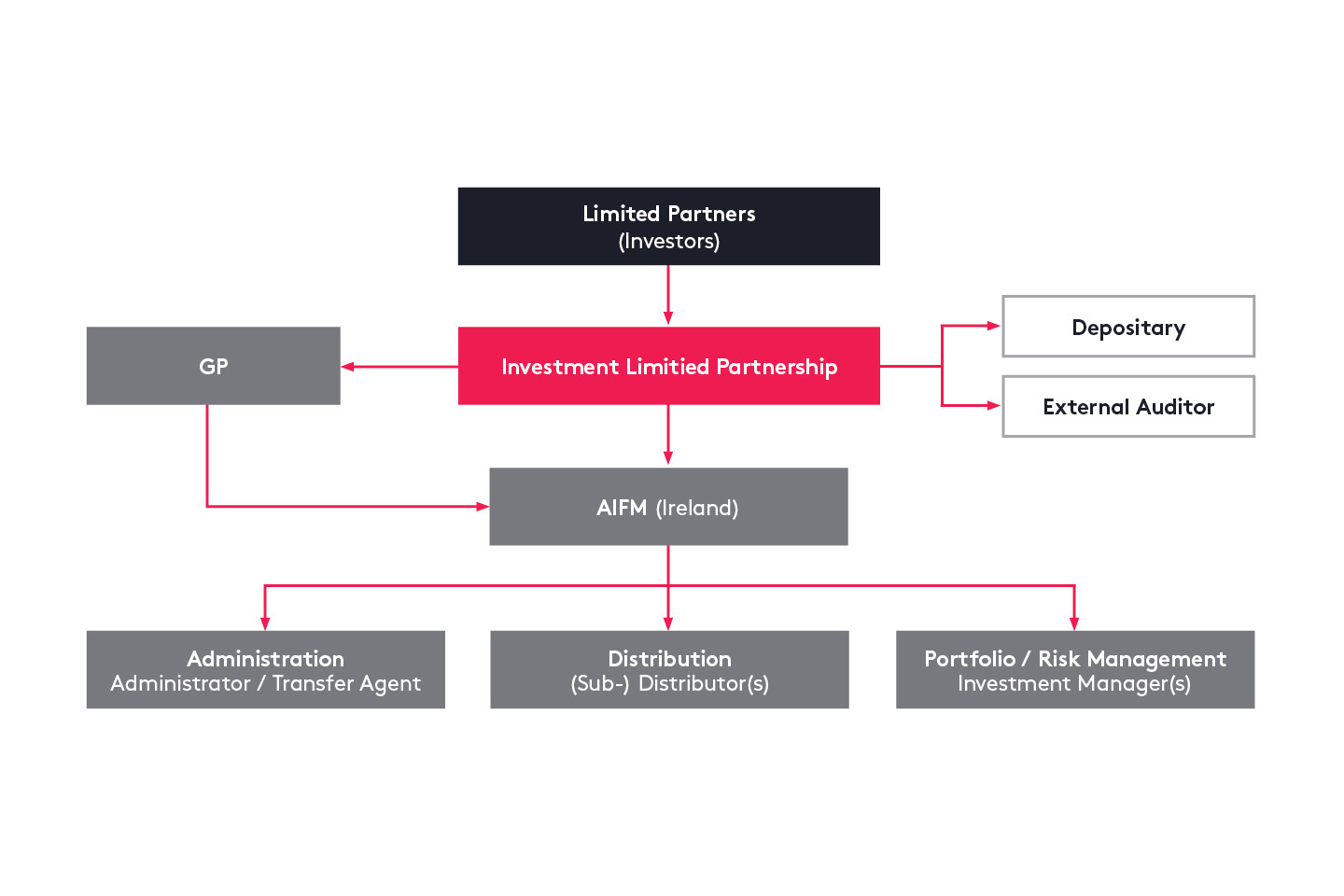
An EEA AIFM or non-EEA investment manager (technically designated as the non-EEA AIFM) is required to be appointed to the QIAIF. An EEA AIFM is required to either be authorised and regulated by the Central Bank or be an EEA AIFM that has passported its management licence into Ireland under AIFMD. The AIFM / non-EEA investment manager is responsible for the risk management and portfolio management functions of the QIAIF. In order to make use of the pan-European AIFMD marketing passport, an EEA AIFM is required to be appointed.
The AIFM / non-EEA investment manager (if no AIFM is appointed) may delegate portfolio management to an EEA or non-EEA discretionary investment manager subject to obtaining clearance from the Central Bank. Non-EEA based investment managers domiciled and regulated in the following jurisdictions may be appointed: Abu Dhabi, Australia, Bahamas, Bermuda, Brazil, Canada, Dubai, Guernsey, Hong Kong, India, Japan, Jersey, Malaysia, Mexico, Qatar, Singapore, South Africa, South Korea, Switzerland, the United States and the United Kingdom.
An Irish depositary authorised and regulated by the Central Bank is required to be appointed to the QIAIF. The depositary is responsible for the safekeeping of the assets of the QIAIF. The depositary's duties also include oversight and cash monitoring.
The depositary may delegate some of its custody functions to one or more sub-custodians and or prime brokers, subject to the requirements of AIFMD.
An Irish administrator authorised and regulated by the Central Bank is required to be appointed to the QIAIF. The duties of the administrator include processing subscriptions, and recording and registering subscriptions. In addition, the administrator performs the role of calculating the net asset value and maintaining and updating accounting records.
At least two Irish resident directors are required for a QIAIF. The directors must be pre-approved by the Central Bank and are subject to its fitness and probity regime.
Other service providers that are required to be appointed to the QIAIF include:
Irish legal counsel
an Irish corporate secretary that will typically also provide the registered office services to the QIAIF
Irish auditors
a money laundering reporting officer
There are various structuring options available for the QIAIF. The QIAIF may be structured as an ICAV, an ILP, investment company, a unit trust or a common contractual fund (CCF).
The ICAV and the ILP are the most popular and commonly used structures for establishing a QIAIF in Ireland. For further details on the Irish Collective Asset-management Vehicle (the ICAV) and the Irish Investment Limited Partnership (the ILP) please see our separate brochures on the ICAV and the ILP.
A typical structure for a QIAIF structured as an ICAV and a QIAIF structured as an ILP are set out below.

Ogier's Investment Funds team in Ireland has substantial experience working with clients across a wide variety of sectors and structures, including private credit, debt, private equity, alternatives, infrastructure, real estate, healthcare, energy, technology and across the full spectrum of fund strategies.
We assist managers and promoters in delivering and maintaining their global investment strategies through Irish fund structures, including QIAIFs. Read more about our Investment Funds services in Ireland on our website.
For further information on the QIAIF or how we can help, contact one of the team via their details below.
Partner | Legal
Ireland
Oisin McClenaghan
Partner
Ireland

Partner | Legal
Ireland

Jennifer Dobbyn
Partner
Ireland

Senior Associate | Legal
Ireland

Simon Keogh
Senior Associate
Ireland
Tax Partner | Legal
Ireland

John Perry
Tax Partner
Ireland

Counsel | Legal
Ireland

Dave Nolan
Counsel
Ireland

Partner | Legal
Ireland

Laura Holtham
Partner
Ireland

Listing Director | Corporate and Fiduciary
Ireland

Margot Carty
Listing Director
Ireland

Associate | Legal
Ireland

Edwina Hilton
Associate
Ireland
Tax Counsel | Legal
Ireland

Arthur Gaskin
Tax Counsel
Ireland
Ogier is a professional services firm with the knowledge and expertise to handle the most demanding and complex transactions and provide expert, efficient and cost-effective services to all our clients. We regularly win awards for the quality of our client service, our work and our people.
This client briefing has been prepared for clients and professional associates of Ogier. The information and expressions of opinion which it contains are not intended to be a comprehensive study or to provide legal advice and should not be treated as a substitute for specific advice concerning individual situations.
Regulatory information can be found under Legal Notice
Sign up to receive updates and newsletters from us.
Sign up