
Oisin McClenaghan
Partner | Legal
Ireland

Oisin McClenaghan
Partner
Ireland



Oisin McClenaghan
Team: Jennifer Dobbyn, Simon Keogh, John Perry, Dave Nolan, Laura Holtham, Margot Carty, Edwina Hilton, Arthur Gaskin
ON THIS PAGE
RELATED
The Irish Investment Limited Partnership (the ILP) is a regulated partnership structure formed under the Investment Limited Partnership Acts 1994, as comprehensively updated and enhanced by the Investment Limited Partnerships (Amendment) Act 2020 (together, the Act).
The ILP is specifically tailored for private equity, alternatives, venture capital and real asset strategies and is based on the Delaware limited partnership structure.
As an alternative investment fund (AIF) the ILP may be authorised and regulated as a Qualifying Investor Alternative Investment Fund (QIAIF) or as a Retail Investor Alternative Investment Fund (RIAIF). The QIAIF ILP is one of the most commonly used structures for Irish AIFs.
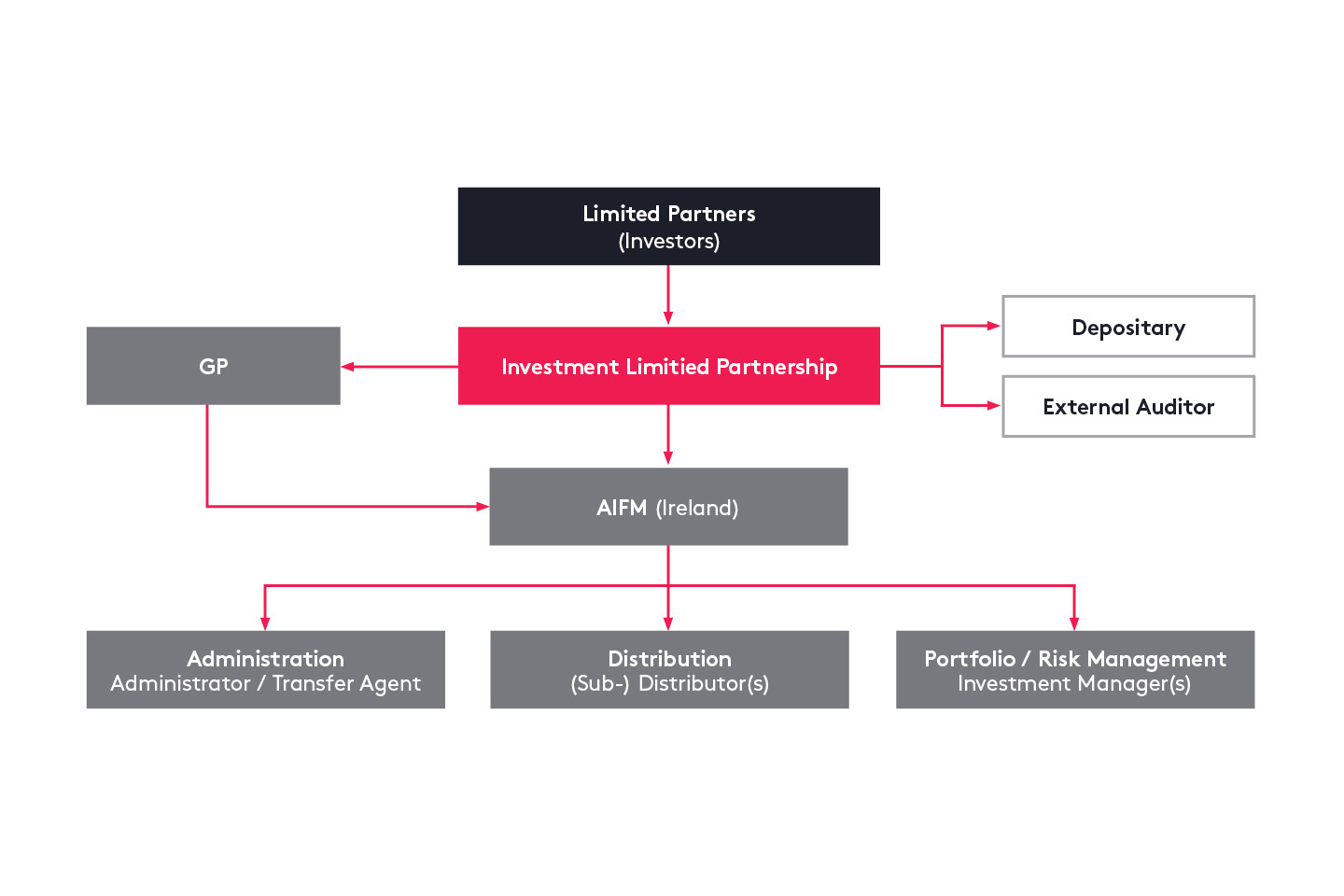
The ILP is formed by way of limited partnership agreement (LPA) entered into between one or more general partner(s) (GP) and one or more limited partner(s) pursuant to the Act, and subject to the authorisation of the Central Bank of Ireland (Central Bank).
The ILP is not a body corporate and does not have a separate legal personality, it will therefore act through its GP. The GP is responsible for the management control and operation of the ILP.
The GP may be a non-Irish entity and is not subject to a separate Central Bank authorisation process, whether an Irish or non-Irish entity. The Directors of a GP are subject to a Central Bank fitness and probity clearance process.
The GP may appoint a non-EEA investment manager directly or may appoint an EEA based alternative investment fund manager (AIFM). An EEA AIFM is required in order to avail of the pan-EEA marketing passport. The AIFM may delegate portfolio management to an investment manager. An investment manager located in an EEA jurisdiction or certain approved non-EEA jurisdictions may be appointed.
For the purposes of this article we have focused on the ILP authorised and regulated as a QIAIF, the most widely use form of ILP.
| Key feature | Information |
| Regulatory requirements |
The ILP is subject to the requirements of the Act, the AIFM Directive (AIFMD) and the Central Bank's AIF Rulebook. |
| Speed to market |
The ILP can avail of the Central Bank's 24-hour fast track authorisation process. |
| Standalone / umbrella structure |
The ILP may be structured as a standalone fund or as an umbrella fund with segregated liability between sub-funds. |
| Liquidity |
The majority of ILPs are typically established as closed-ended. However, it is also possible to establish an ILP as open-ended or open-ended with limited liquidity. |
| General partner |
The GP to the ILP is not required to be an Irish entity, it may be a body corporate or a partnership. However, typically the GP will be a corporate entity. The directors of the GP must be approved by the Central Bank and are subject to its fitness and probity regime. |
| Limited partner liability |
Limited partners (LP) benefit from limited liability. Provided the LPs do not take part in the management of the ILP, the liability of the limited partners is limited to its capital committed and outstanding commitments. The ILP Act includes a comprehensive list of activities which may be undertaken by LPs without breaching their limited liability protection. The GP has unlimited liability for the debts and obligations of the ILP. |
| Limited partner number |
There is no limit on the number of LPs for an ILP and there can be as few as one LP. |
| Minimum permitted investment and investor criteria |
The minimum initial investment in a QIAIF is €100,000. The categories of investor that a QIAIF may be marketed to are restricted to those that satisfy the ''qualifying investor'' criteria. |
| Investment restrictions |
The ILP is suitable for a broad range of asset classes. There are limited investment restrictions, save for those that are loan origination and Irish property QIAIF ILPs which are subject to additional regulatory requirements and investment restrictions. There are no risk-spreading requirements therefore the ILP may have a highly concentrated portfolio / single asset. |
| Leverage |
There are no borrowing or leverage limits (subject to the limits disclosed to investors). |
| Service providers |
Required service providers to the ILP include:
The AIFM / non-EEA investment manager (if no AIFM is appointed) may delegate portfolio management to an EEA or non-EEA discretionary investment manager subject to obtaining clearance from the Central Bank. Non-EEA based investment managers domiciled and regulated in the following jurisdictions may be appointed to ILPs, subject to Central Bank clearance: Abu Dhabi, Australia, Bahamas, Bermuda, Brazil, Canada, Dubai, Guernsey, Hong Kong, India, Japan, Jersey, Malaysia, Mexico, Qatar, Singapore, South Africa, South Korea, Switzerland, the United States and the United Kingdom. |
| Structural features |
Additional structural features such as feeder vehicles, carry vehicles, co-investment vehicles, parallel vehicles and the establishment of subsidiaries may be availed of. |
| Limited partnership agreement changes |
Changes to the LPA can be made with the approval of the majority of the LPs. There is flexibility in terms of defining how this "majority" is determined in the LPA (e.g. majority by class, value or number). Changes to the LPA may be made without the consent of LPs where the depositary to the ILP certifies that the changes do not prejudice the interests of the LPs. |
| Typical private equity features |
Typical private equity fund features may be availed of, for example capital accounting, excuse and exclude provisions, capital commitments and contributions, drawdowns, defaulting investor provisions, carried interest, distribution waterfalls and advisory committees. |
| Side letters |
Side letters may be entered into setting out particular terms agreed between the GP and a LP, subject to the requirements of AIFMD. |
| Tax features |
The ILP is a tax transparent vehicle. All income gains or losses of an ILP are treated as accruing to each LP for Irish tax purposes as if such income, gains or losses had accrued to the LPs without passing through the ILP. Generally there is no Irish stamp duty on the transfer, re-purchase or redemption of partnership interests in an ILP. The management and administration services to an ILP are VAT exempt. |
| Marketing |
An ILP which appoints an EEA AIFM pursuant to AIFMD may avail of the pan-EEA marketing passport. An ILP which appoints a non-EEA investment manager and no AIFM, may only be marketed under national private placement rules (where available). |
| Migration |
The migration of an ILP into and out of Ireland by continuation on a statutory basis is provided for under the Act. |
Ogier's Investment Funds team in Ireland has substantial experience working with clients on the structuring, authorisation, ongoing servicing, distribution and maintenance of ILPs across the full spectrum of underlying fund strategies.
We assist managers and promoters in delivering and maintaining their global investment strategies through Irish fund structures, including ILPs. Read more about our Investment Funds services in Ireland.
For further information on the ICAV or how we can help, contact a member of the team via their details below.
Partner | Legal
Ireland
Oisin McClenaghan
Partner
Ireland

Partner | Legal
Ireland

Jennifer Dobbyn
Partner
Ireland

Senior Associate | Legal
Ireland

Simon Keogh
Senior Associate
Ireland

Tax Partner | Legal
Ireland

John Perry
Tax Partner
Ireland

Counsel | Legal
Ireland

Dave Nolan
Counsel
Ireland

Partner | Legal
Ireland

Laura Holtham
Partner
Ireland

Listing Director | Corporate and Fiduciary
Ireland

Margot Carty
Listing Director
Ireland

Associate | Legal
Ireland

Edwina Hilton
Associate
Ireland

Tax Counsel | Legal
Ireland

Arthur Gaskin
Tax Counsel
Ireland
Ogier is a professional services firm with the knowledge and expertise to handle the most demanding and complex transactions and provide expert, efficient and cost-effective services to all our clients. We regularly win awards for the quality of our client service, our work and our people.
This client briefing has been prepared for clients and professional associates of Ogier. The information and expressions of opinion which it contains are not intended to be a comprehensive study or to provide legal advice and should not be treated as a substitute for specific advice concerning individual situations.
Regulatory information can be found under Legal Notice
Sign up to receive updates and newsletters from us.
Sign up